

ARTECTURE: a Q&A With Artist Carmen Sanchez Ruda
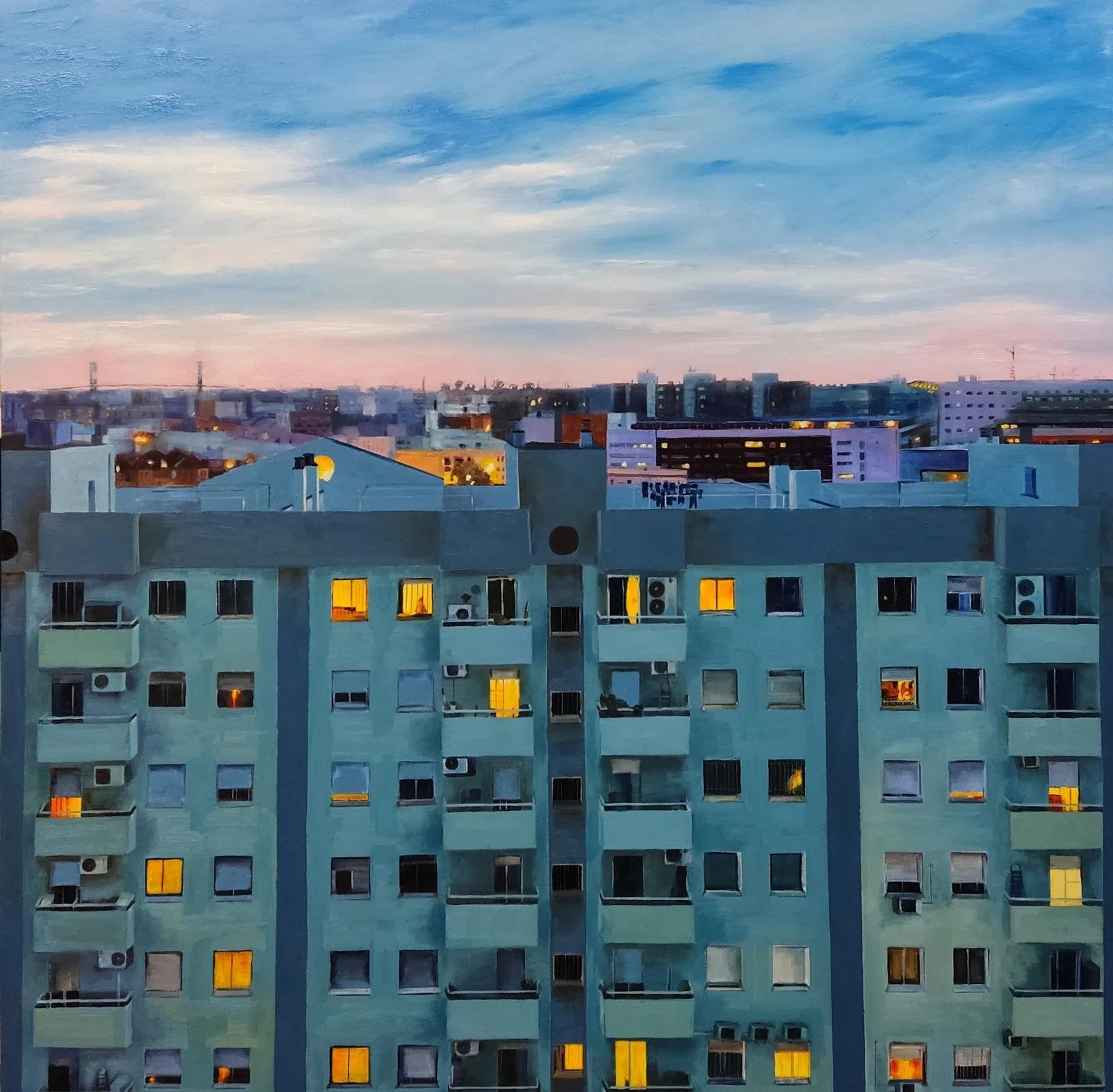
An artist’s surroundings often shape their work. At the same time, the art they create has the power to reshape the way they experience those surroundings. It may not change where they live or what they do, but it can transform how they interact with the environment around them. It turns the daily interplay with life into something newly observed and understood.
For Spanish artist Carmen Ruda Sanchez, this symbiotic relationship between place and perception is at the core of her work. Speaking with us from her home in Seville, Spain, she reflects on her creative process and the inspiration she draws from both nature and the city. Her urban-inspired works, which she coined “artectura,” blend art, architecture, and life into uniquely structured pieces. They capture the lines and order of city living while still preserving the character, color, and essence that gives a city its soul.
Q: Could you talk about your journey into the art space? What initially drew you to the visual arts and led you to become a professional artist?
A: From a young age I liked to paint, and I learned from my great-aunt, who was self-taught. My grandmother would buy me tempera paints, brushes, and sketchbooks. It felt like a reward to me. Later, I studied Fine Arts so I could continue creating what I loved.
Q: As you just mentioned, you have studied Fine Arts and also Art History. How has your educational background influenced your creative approach and the development of your artistic identity?
A: Fine Arts provides training in painting and restoration. From there, you have to keep learning every day. My passion is painting, and my profession is restoration.
Q: That’s beautifully said. If you get to wake up and work in your passion each and every day, you should consider yourself very lucky. You’ve worked as an art restorer and conservator. How has that technical work influenced your own creative practice?
A: Art restoration influences me much more than I myself realize. A great deal of patience is required to work as a restorer, and I devote a lot of time to my own work. Restoration work is very delicate, and to create you also need a great deal of sensitivity. These two qualities go hand in hand for me.
Q: What is your artistic process like, from the initial idea or concept to the final finished piece? Do you typically start from a sketch, an emotion, or another point of departure?
A: Sometimes it’s a photo, sometimes a sketch, sometimes a concept. Afterwards, I try to capture it on canvas. The painting begins with drawings, stains, brushstrokes, and excitement. You don’t always get a good result, but everything is a learning experience that allows you to keep moving forward.
Q: Nature, gardens, and urban landscapes appear frequently in your work. As you know, your urban series is what initially attracted us to your work. What is it about this variety of spaces that connects so deeply with you?
A: My work connects with the place where I live. If I’m in Ayamonte, my mind relaxes and materializes the work, usually in nature. When I live in Seville, my mind is inspired by the city to create urban corners. I call them Artecture—art, architecture, and life.
“The city especially attracts me; its chaos, noise, lights, and lines all motivate me to create urban works.”
Q: I love that word—Artecture. In some of your pieces, you toy with reality through distortions, the use of patterns, and other visual effects. What draws you to combining the figurative with the conceptual?
A: My painting is figurative, but sometimes I play with distortion so that the viewer asks and thinks about what happened to the painter to change language within a single work. It’s a way of giving a deeper message to figurative art.
Q: Where do you find inspiration in your everyday life? Are there specific places, memories, or emotions that constantly feed your work?
A: I find inspiration while walking through the city, searching for urban corners. The city especially attracts me; its chaos, noise, lights, and lines all motivate me to create urban works.
Q: Could you share a specific moment, perhaps it was a trip, an encounter, or a previous job, that changed the way you understand your own work?
A: A cultural project I participated in that dealt with urban themes led me to delve deeply into urban art. From that point on, I worked on this theme with great enthusiasm, progressing little by little and with pleasure. Today it is my favorite subject and one that completely fulfills me.
Q: Your work was presented in Times Square, New York, with Ad Infinitum. What was it like to see your work in such an iconic and global space? What did that milestone mean to you?
A: Having my work on screens in New York was very positive. Sharing your work is important for moving forward. New York is a very important place in the art world, and being there is like a dream. It was truly a dream come true.
Q: Looking back, which exhibition or project has been the most significant of your career so far, and why?
A: All of my solo exhibitions are very important to me; they all leave me with positive memories and valuable lessons. Working in groups, with collective exhibitions and projects, is also enriching. Working with my colleagues is very important to me. I am constantly learning new skills from them.
Q: What do you love most about being an artist? Is it the act of creating, the dialogue with the audience, or something else?
A: My time working in the studio is the most pleasurable. Conceiving ideas, thinking, working, correcting, refining, sketching, fieldwork. Those are all things that I enjoy most in the creation of a piece.
Q: Is there a dream project you haven’t yet realized but would like to carry out in the future?
A: I would like to carry out many projects. I always have ideas in my head to create. My mind never stops for a moment. I still have so much to learn, so much to work on, so much to research. I don’t want to stop at any point. I want to keep moving forward.