

Colorful lines: a Q&A With Alyssa Stevens
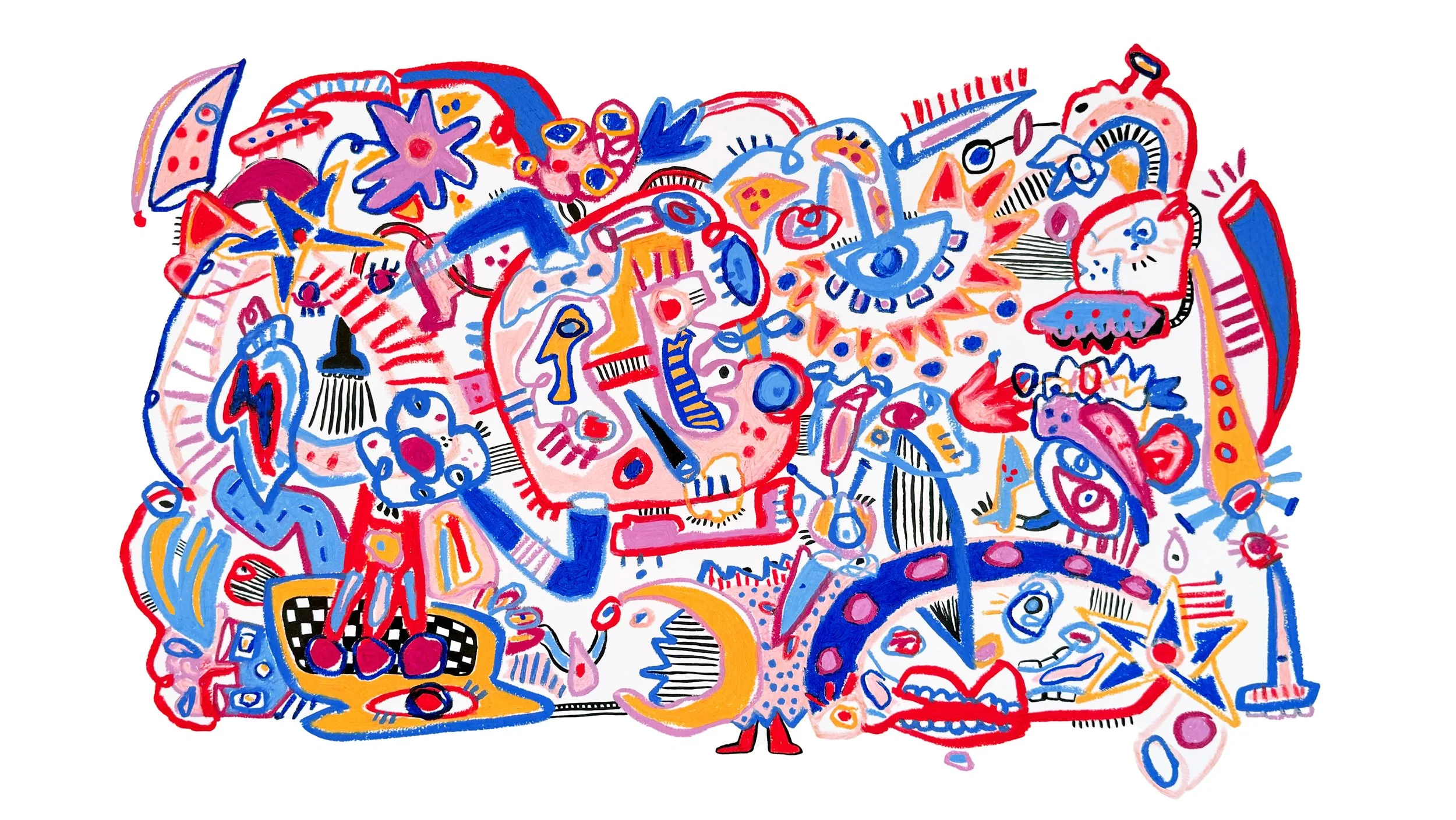
Photo courtesy of Alyssa Stevens
We got to speak with New York-based artist, Alyssa Stevens, regarding her process as she creates art, her vibrant use of color and the meaning behind her collection, Dream Stations.
Q: Let's start at the beginning. Like most children, can I assume you grew up drawing and doodling. What fond memories do you have about this child's play? And did you always express an interest in art?
A: I always loved to draw and color, like most kids. When I was young, my grandma bought me this extra large box of Crayola crayons with the built-in sharpener and it became my prized possession.
I have a vivid memory of my cousins coming over and scattering them all over the floor and using them carelessly. I ended up having a full on meltdown, which was pretty out of character for me. Growing up with siblings, I was always good at sharing, but I guess I was just extra protective over my art supplies.
Looking back at childhood photos, I sometimes see my artwork in the background, hung up on the refrigerator. It’s so messy and colorful, and I think my current art practice has taken inspiration from that - the desire to create freely with no limitation or thought; just pure feeling and connection.
Throughout school, I would always doodle in my notebook, almost as a way for me to self-soothe. It actually helped me to focus when I was able to just let my hand move across the page. It was meditative in a way.
Q: (laughing) You just unlocked a childhood memory of mine when you mentioned the crayon box with the built-in sharpener. It took me back to a much simpler time. It is always interesting to reflect back on your past interests and to see how they develop into either past hobbies or into fleshed out passions. Looking back, at what point did you realize that art was what you wanted to pursue?
A: When I was in high school, I became more aware of how important creativity was for me. Before that, I had created a narrative in my mind that I was “bad” at art and I felt a lot of shame around it.
Then I started doing “art intensive,” which was basically an independent art session after school every day. There was some mentorship but it was very open-ended and self-guided, which allowed me to experiment and really find my own voice and style. I leaned into abstraction and line work, which feels like the foundation of my artwork today.
Q: You studied at Bentley University and then worked in social media advertising. There is so much structure and artistic boundaries in a corporate role that seem to mold your days, week after week. How did you navigate that corporate construct while still expressing yourself creatively?
A: When I first started out in the corporate world, I was a data analyst and had to learn how to code. I hated it, and spent many late nights and weekends working to hit deadlines. I quickly burnt out and was able to switch roles internally, moving to the paid social team which was much more aligned. While it still was structured, it was definitely a lot more creative and I enjoyed the work itself for the most part.
However, I struggled with the corporate environment and felt like I had to wear a façade every day. Outside of work hours, I made a lot of art as a way to cope with everything going on in my life. I felt so out of alignment and art helped me to express that frustration and put it somewhere, instead of holding onto it. It was an important outlet for me.
Q: Thanks to unexpected success selling out your first collection, Interconnected Planes, you were able to quit your 9-5 to pursue your art full-time. Did you have any hesitation making this decision?
A: I had no hesitation quitting my job, although I probably should have. I honestly felt so burnt out and my goal was always to find a way to support myself from my art, so as soon as it happened, I took my chance and quit. Now that I'm older, I do look back on that moment and think how crazy that was, but I'm proud of myself for taking the leap.
Q: You've described your creative process as a type of "connected flow state" where an artist channels their energy. Can you take us into your mindset when this is happening? What does it actually feel like in the room when you're in that state?
A: Being in a flow state feels like working on auto-pilot, but in the best way. It feels like a higher power is working through you, and you are simply the channel that energy is moving through. When I was young, I struggled with my confidence and trusting in myself; being in a flow state is like feeling complete trust. There are no thoughts going through my mind, just an inner-knowing being translated into the physical world through my hands.
Q: The use of the full color spectrum is central to your work. Each color seems to layer and thread itself with the next, almost giving each piece a tactile effect. How do you approach color? Is it instinctive? Methodical? Or is there a natural cadence that you follow as you work on a piece?
A: Choosing my color palette feels intuitive, but it also involves some experimentation. When I first started using oil pastels, I wanted to stick with the same colors I felt comfortable with - mainly primary colors. After a while, I stepped out of my comfort zone and tried more pinks and purples, which are now some of my favorite colors to use. I think color choice is something that will always evolve over time, and reflects where you are at a point in time. Right now, I love pink, a color I used to hate. It feels soft, feminine and playful, which is something I feel more drawn to exploring in my work.
Q: Oil pastel is often considered by many to be a hybrid medium bridging the gap between drawing and painting. There is plenty of discourse in the art world about where exactly oil pastels land on the art landscape and how close it flirts with being considered fine art. What drew you to it specifically, and what versatile features does it boast that other mediums cannot provide?
A: I would love to start by saying that there are high-end oil pastel brands used in fine art. The Sennelier oil pastels I use were originally created for Picasso and became the first professional-grade oil pastels to exist.
Interviewer: Really? I had no idea! That’s really interesting.
A: But back to your question, every time I went into the art store, there was a section with these extra large Sennelier oil pastels. The color range was beautiful and each shade was so vibrant. I finally decided to buy a few, and loved the texture and consistency of them. I never felt like painting with a paint brush came naturally to me, so I loved being able to hold an oil pastel like a crayon, considering line work is at the core of my work. The main down side of oil pastels is that they never fully dry, so I have to protect my artwork carefully and get finished pieces custom framed behind glass, which is definitely an investment.
Q: Your work often features fragmented faces and eyes, with Picasso and Matisse being considered some of your influences. Is there something about including a face in your art that helps personify the pieces?
A: I think drawing abstracted faces and facial features comes intuitively. I always say everything I make is a self-portrait, and I love how distorted and imperfect they are. I also think eyes feel so significant, as they are a central point of connection. They feel like a symbol of interconnectedness.
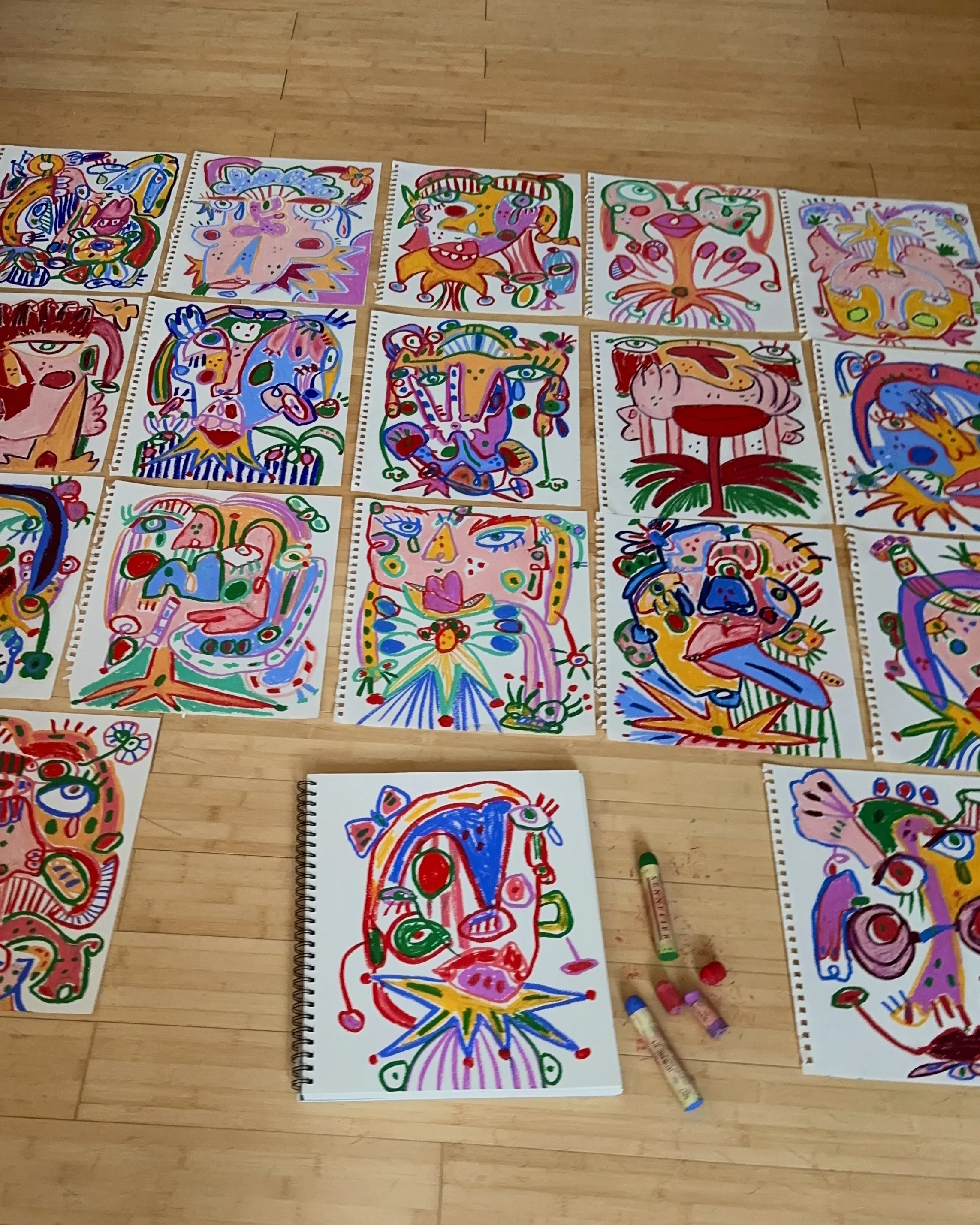
Photo courtesy of Alyssa Stevens
Q: Your artistic style is whimsical, playful and sometimes, by some art world standards… messy. Lines are not always linear, sometimes the color lays outside of them and there is a carefree, fluidity that is compelling. How do you protect those characteristics that make your art so unique when so much of the world around us requires us to be more polished or neat?
A: It’s something I’m always balancing. I feel like some of my more recent work feels more rigid and structured, and I find myself wanting to move back towards creating more fluidly. Making art feels the most cathartic when I’m expressing myself freely, without overthinking, so that’s how I try to approach the process.
I also think the fact that so much of life is about being neat and polished and perfect gets exhausting, and my art allows me to release all of that and just let myself exist in my most natural state.
Q: Your practice is rooted in what you call the space between worlds — memory, longing, connection. Where do those in-between feelings come from for you personally? Are you drawing from specific memories or a more general emotional landscape?
A: A lot of them feel connected to places from my childhood, but there is also a tie to an intangible energy which exists beyond the veil of the physical world. Places that feel almost dreamlike, but real.
Q: Can you take us into the perfect environment to create your art? Is there a time of day where you tend to be more productive? A special playlist that plays? Any artistic rituals that take place to ensure your creativity effortlessly flows?
A: I am most creative in the afternoons and evenings. I prefer to do more administrative tasks earlier in the day. I have many playlists, but Lana Del Rey is always on repeat, along with Beach House and Blood Orange. Sometimes I just listen to healing frequencies in the background. I always love to light a candle when I create.
Q: Your collection, Dream Stations, is very compelling not only because of the art itself, but the story behind it. You spoke about the facade of societal structures we’re presented with throughout our lives; the classroom, the office, the illusion of an American Dream and how, from afar, they look inviting, offering the promise of safety, comfort, even purpose. But once in the midst of it all, you realize it was all a ruse. The societal structures became constructs; mere perception benders that took your form of reality and turned it into something unvarying. Now that you are working on your terms, at your own pace and with your own creative influences, do you feel the same about your surroundings? Or have you found that expressing your art has provided a haven from the societal norms we are pushed towards throughout our lives?
A: I definitely feel like pursuing art has allowed me to resist the more structured aspects of society, which I’m grateful for. However, it demands a lot of discipline and delusional self-belief to make a living from your art, and I have moments where I miss the security and stability of having a job. Yet I’m always reminded by the Universe that I’m on the right path and this is what I'm meant to do in this lifetime.
Q: Your work has been showcased in exhibitions everywhere from the art-forward town of Marfa, Texas to Art Basel Miami to Bali. Do you approach the creation of your work the same depending on where it will be displayed?
A: No, I rarely think about where my work will be displayed during the creation process. There may be physical constraints I have to keep in mind, like the size of the piece, but other than that, I definitely approach it as I would any other art piece.
Q: If a stranger walked into a gallery and stood in front of one of your paintings with no context — no artist statement, no title, nothing — what would you hope they felt?
A: I think whatever message needs to come through for someone will come through. However, I would hope someone looks at my art and feels seen, and less alone.