

Floating Girlhood and Peaceful Absence: Natsumi Hayashi
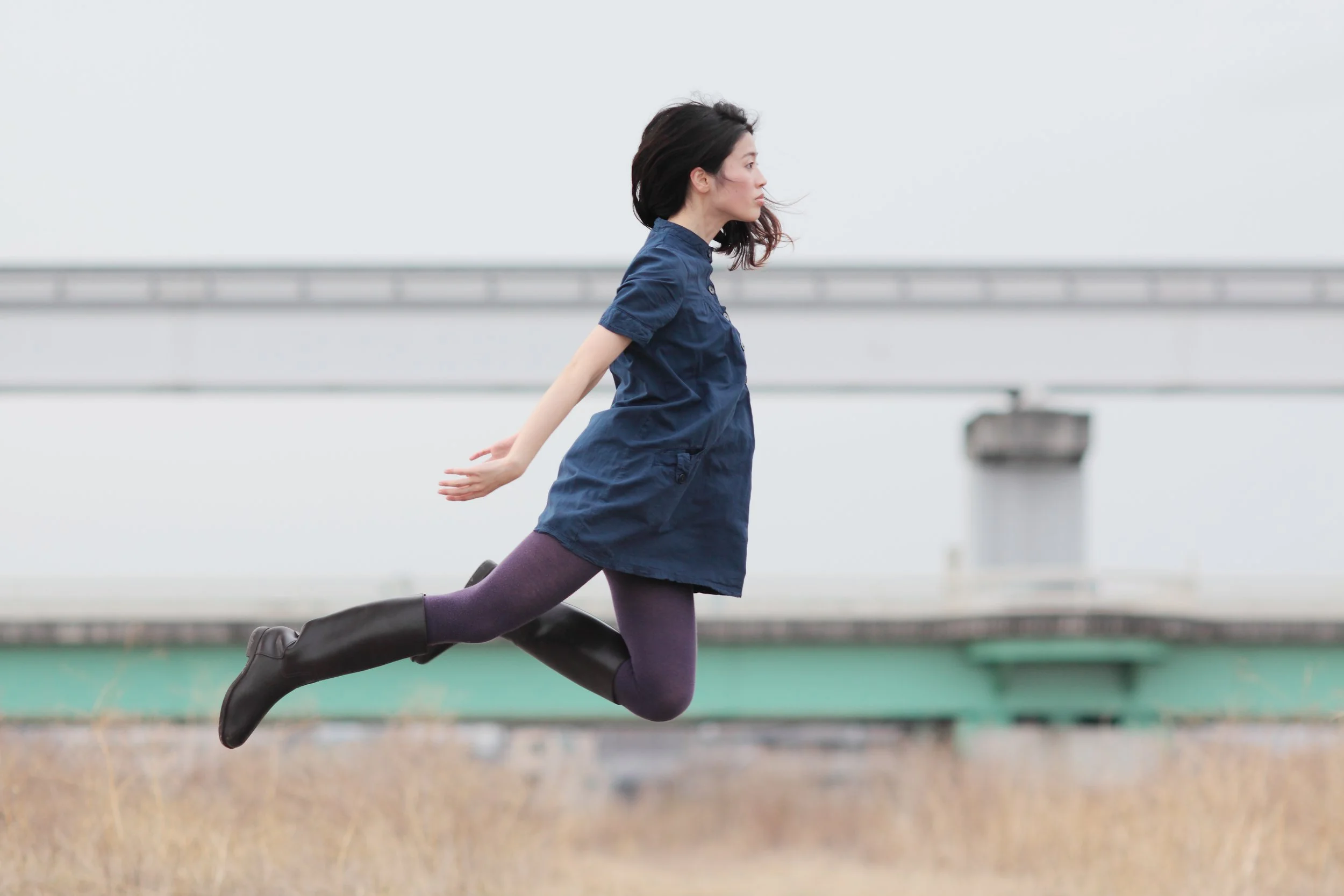
Photography by Natsumi Hayashi
A woman floats in the air, half falling, half rising. The camera freezes her in motion, as it does the sun, the tree, the city, and the passers-by.
“Today’s Levitation” was my first exposure to the work of Japanese contemporary photographer Natsumi Hayashi. To create this series of self-portraits, Hayashi used a shutter speed of 1/500 or faster to capture herself defying Earth’s gravity: an inescapable shackle each human lives under since the moment of birth.
The project began on January 1, 2011, when Hayashi started sharing photos of herself “floating” on her website as a fictional blog, “Yowa Yowa Camera Woman Diary”.
In these photographs, Hayashi floats in mid-air. In some, she looks contemplative. In others, one senses a childlike playfulness. The artist treats gravity and the need to plant one’s feet in solid ground as metaphors for burdens that human beings must carry in their lives. In contrast, the state of levitation represents liberation from the weight of real life.
“For me, levitation is the feeling of being between dreams and reality,” Hayashi told me in an email correspondence. “When I was a child, on typhoon days I would run alone with an umbrella and feel as if I might fly away into the sky. Levitation carries that same feeling for me.”
This deep interest in the space in between gave rise to two concurrent, ongoing series, splitting the artist’s focus between reality and fantasy.
The first body of work, titled “Salvation,” is a cellphone photography series that inherited the diary structure of “Today’s Levitation.” Now consisting of over 1,100 images, this remains Hayashi’s largest and longest-running body of work.
Fair to say, “Salvation” is a step back from the artist’s bodily existence and a step closer to the city and streets that too often fell into the background. In a sense, it is the next stage of liberation from “Today’s Levitation,” where the artist is now freed from physical confinement altogether.
The absence of the figure in “Salvation” is not erased. Rather, it allows the mind’s eye to freely focus on things that are often made invisible by the busy bodies in the city: flower pots lined up at the bottom of an old wall, a “Graffiti is crime, you’re under surveillance” sign in Saitama, or a taped-up window in Shibuya. Removed from their original context, these images became memories of the city. They carry aged calmness like settled dust after centuries have passed.
“When I saw Matisse’s paintings, I felt that being alone was not something to fear. Even in a room full of people, I felt a quiet sense of solitude, and that solitude was not sad,” said Hayashi. “That experience became one of the starting points of SALVATION.”
Happening alongside “Salvation” is “THE GIRL,” a series that combines the best of both worlds from “Today’s Levitation” and “Salvation.”
“THE GIRL” marks an unexpected turn in Hayashi’s practice, as the artist transitions from traditional craft into a highly controversial area. Referring to generative AI as a “transparent camera,” this series is generated through Hayashi’s conversation with a technology that is currently under severe scrutiny.
Regardless of one’s stance on gen-AI, we cannot deny that Hayashi’s AI “photography”, or “thoughtographs” as the artist calls them, belongs in her photographic practice and can stand as a consistent body of work on its own two feet.
Many focal themes in Hayashi’s existing practice reappear in “THE GIRL.” We could see traces of “Today’s Levitation” and “Salvation” in the composition, movement, and the use of cityscapes and streetscapes.
For example, many of the girls remain levitated, paying tribute to the artist’s debut work. Interestingly, the characters in the latest series looked significantly younger, standing on the cusp of girlhood, right before entering womanhood. They play and float through playgrounds, back alleys, and school infirmaries – familiar scenes that could’ve belonged to “Salvation,” drawing delicate connections between the two bodies.
“THE GIRL is closer to dreams, while SALVATION is closer to reality. But in my mind, they are connected,” Hayashi explained. “In my actual creative process, places I photograph for SALVATION sometimes become the setting for THE GIRL. Landscapes I discover in the real world can transform into dreamlike scenes through dialogue with AI.”
Given that gen-AI is responsible for a new level of exploitation of individuals, especially women in low-income communities and less-developed countries, using gen-AI to explore the tenderness and playfulness of girlhood seemed self-conflicting at first.
In response to this contradiction, Hayashi stated that she held herself accountable to remain conscious of the controversies behind its development and advancement and continued to evaluate her engagement with the tool:
“Our daily lives are supported by many forms of invisible labor—through food, clothing, smartphones, and the internet. I am not outside of those structures. Rather than simply criticizing others, I want to think about these issues [with AI] while recognizing that I am also part of them.“
When asked if she will continue to use AI as a creative tool, Hayashi’s answer was an unhesitant yes:
“To me, AI felt like a new kind of magic, much as photography, telephones, and the internet once did. And like any form of magic—or technology—it can be used to help people or to harm them. I want to continue learning, thinking, and discovering as I work with AI. I want to explore ways of using it that bring happiness rather than harm.”